


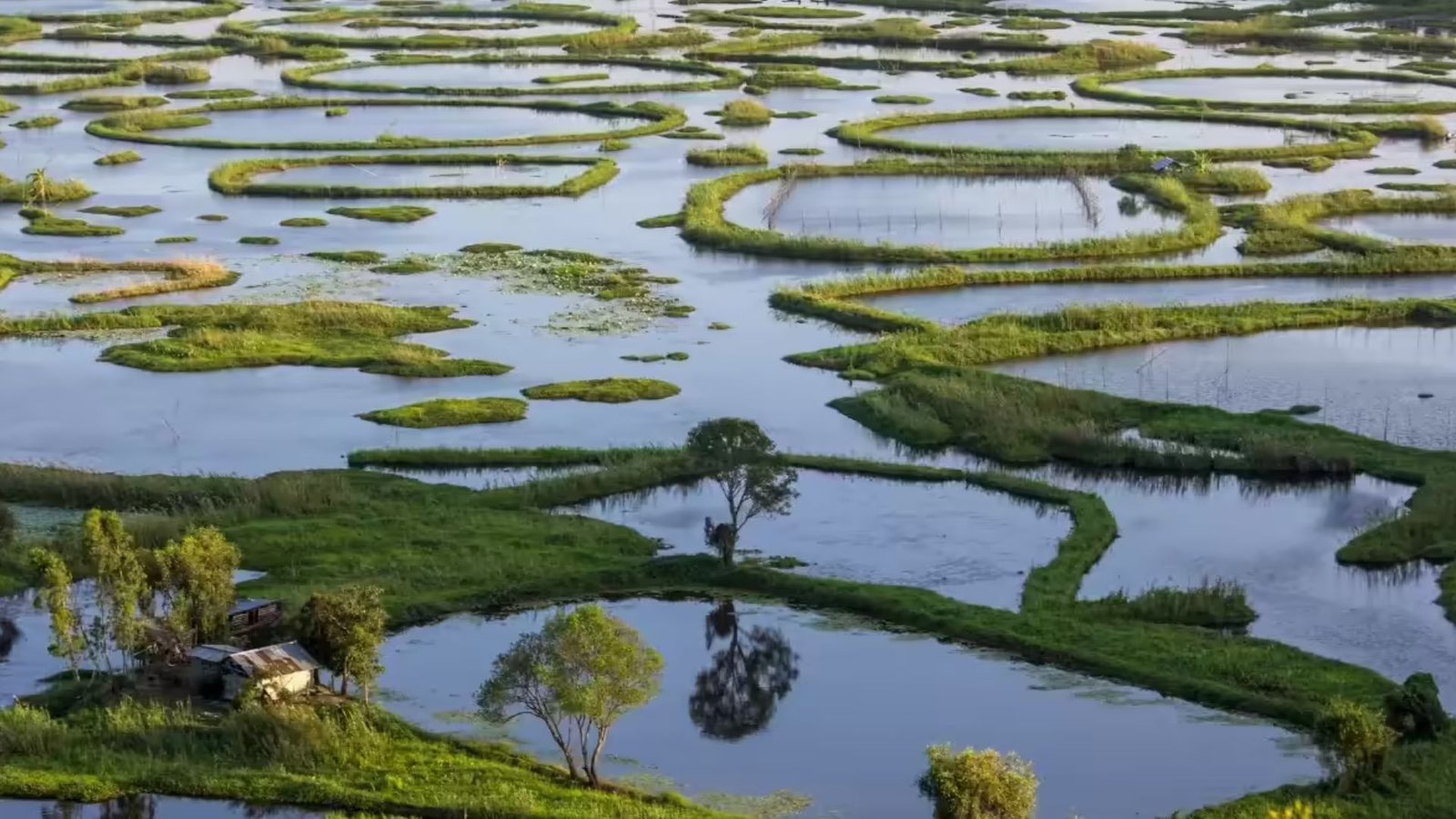
People live on Loktak Lake in Manipur, India, by building bamboo-and-thatch huts called phumshangs on phumdis, which are floating mats of vegetation, soil and decaying roots. Fishermen travel by canoe, cut phumdi into circular fish traps called athaphum, and share the lake with Keibul Lamjao National Park, the world’s only floating national park.
If you have ever wondered how anyone can build a home, run a school or protect a deer on land that moves, this guide answers it. You will also get everything you need to visit: how to reach Loktak Lake, permits, park fees, the best time, where to stay, what to eat and how many days to plan.
Your Next Adventure Starts Here!
Loved discovering the mysterious history of Dhanushkodi? Explore more incredible destinations, hidden places and real travel experiences across India with BharatBhramanLife.
Explore More Travel Guides →Loktak Lake quick facts
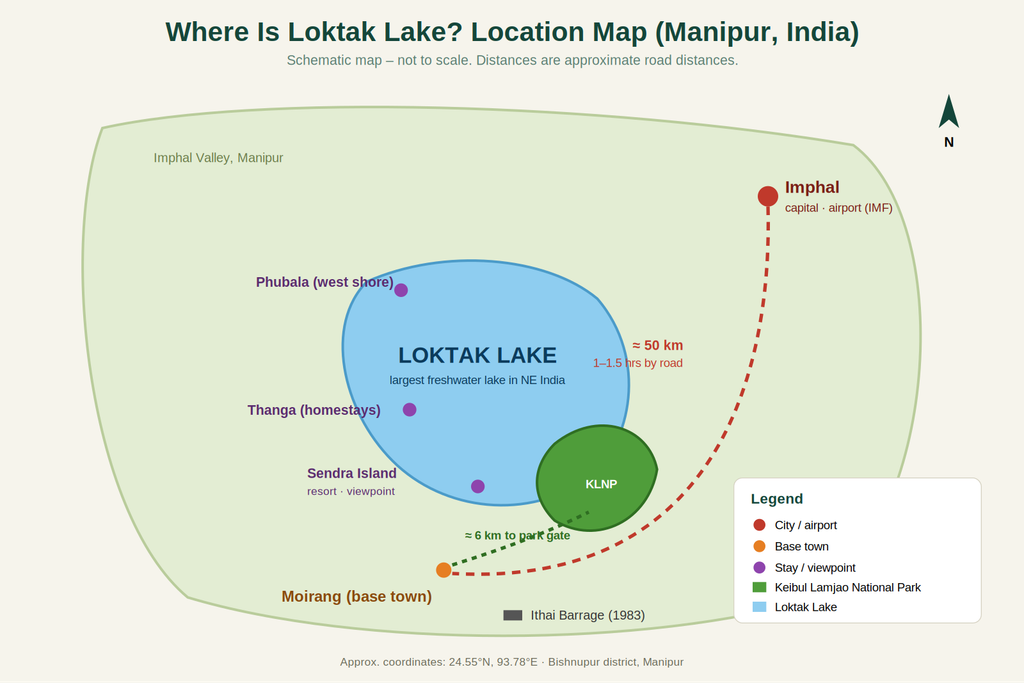
- Location: Moirang area, Bishnupur district, Manipur, about 50 km south of Imphal.
- Why famous: Largest freshwater lake in Northeast India and home to floating phumdis.
- Lake size: Typically around 287 km², swelling up to about 500 km² in the rainy season.
- Largest phumdi: About 40 km² on the south-eastern shore, carrying Keibul Lamjao National Park.
- Ramsar status: Designated a Wetland of International Importance on 23 March 1990 and added to the Montreux Record in 1993.
- People: Around 100,000 people live in 55 hamlets around the lake, and roughly 4,000 are often cited as living on the phumdis themselves.
- Fish: About 1,500 tonnes are caught every year.
- Famous resident: The endangered sangai, or dancing deer, Manipur’s state animal.
What are the floating islands of Loktak Lake called?
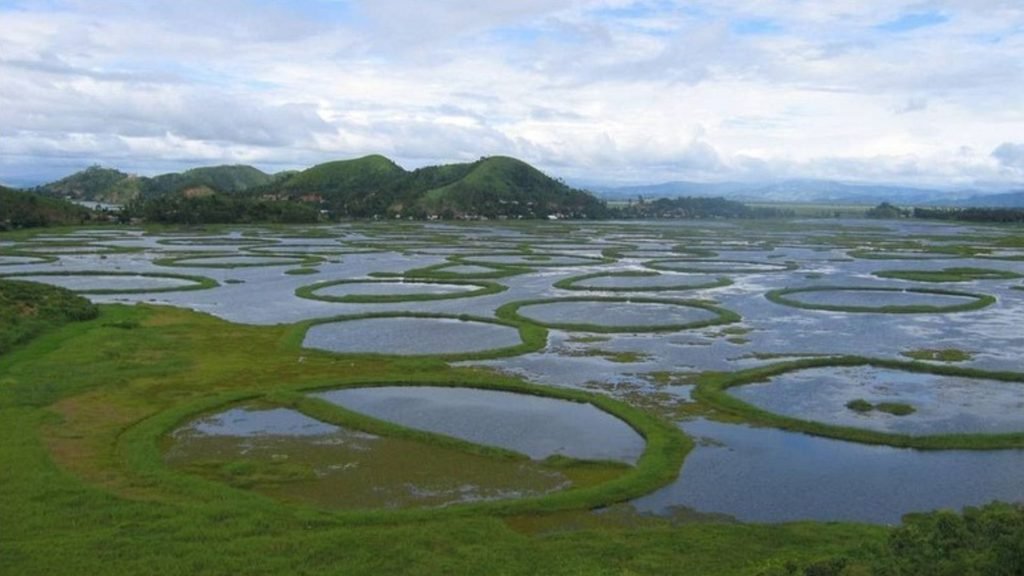
They are called phumdis. A phumdi is a heterogeneous mass of vegetation, soil and organic matter at different stages of decay. Over time it thickens into a spongy, solid mat. Walking on one feels a bit like walking on a trampoline.
Phumdis range from a few centimetres to several metres thick, and like an iceberg, most of their bulk sits below the waterline. Locals call a hut built on a phumdi a phumshang, and the circular rings of phumdi that fishermen cultivate for fishing are called athaphum.
How is Loktak Lake floating? The science in simple words
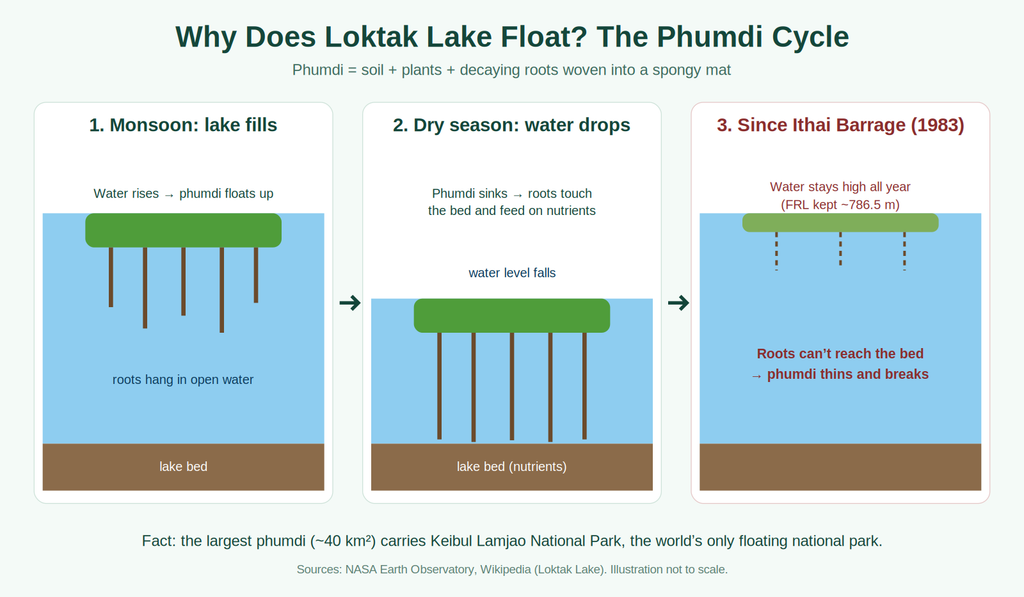
To be precise, the lake is not floating. The phumdis are. They are lighter than water because they are made of plant roots, trapped gas and partly decomposed matter, so they stay at the surface.
The real magic is the seasonal cycle. When the monsoon fills the lake, phumdis rise. In the dry season the water drops, the phumdis sink slowly, and their living roots reach the lake bed to absorb nutrients. That feeding is what keeps them thick and green.
This cycle broke down after the Ithai Barrage was built in 1983 for hydropower. Water now stays high through the year, so roots struggle to reach the bottom and many phumdis are thinning and breaking apart.
How do people live on Loktak Lake’s floating islands?
Life on the lake follows the rhythm of water, fish and weather. Here is what daily life looks like.
- Homes: Families build phumshangs from bamboo, reeds and thatch directly on the phumdis. They are light, repairable and built to move with the water.
- Fishing: The lake is a lifeline for fishermen. Many use athaphum, circular rings of phumdi that attract fish and make them easier to net. The lake’s annual catch is about 1,500 tonnes.
- Transport: Wooden canoes are the school bus, taxi and market cart. People paddle between islands to trade, study and visit relatives.
- Education: A floating elementary school opened on the lake in 2017, so children no longer have to commute to the shore.
- Food and income: Besides fish, people harvest lotus stems and seeds, water chestnut and other water plants. Plants like these have declined as pollution has increased.
- Culture: Loktak is tied to Meitei folklore and identity. Loktak Day is observed every year on 15 October.
It is a hard life as much as a beautiful one. Many phumdi families have faced eviction and relocation since the Manipur Loktak Lake (Protection) Act of 2006, and debates over tourism, ownership and conservation are still ongoing. When you visit, choose community-run homestays so your money reaches local families.
What is Keibul Lamjao National Park?
Keibul Lamjao National Park is the world’s only floating national park. It sits on the largest phumdi on the south-eastern edge of Loktak Lake and covers roughly 40 km².
The park exists for one animal: the Sangai (Rucervus eldii eldii), also called the brow-antlered deer or dancing deer. Its hooves are adapted to the soft, bouncy ground, and its graceful gait gives it the nickname. The sangai was once feared extinct, was rediscovered in the early 1950s, and numbered only about 14 in 1975. The widely cited 2016 census counted around 260.
It is listed as Endangered on the IUCN Red List, protected under Schedule I of the Wildlife Protection Act 1972 and in CITES Appendix I. The park also shelters hog deer, otters, wild boar and over a hundred bird species.
Why are the floating islands under threat?
- Ithai Barrage: Year-round high water starves phumdi roots of nutrients and thins the mats.
- Pollution: Sewage from Imphal and silt from the catchment feed water hyacinth and eutrophication.
- Too many athaphums: Artificial fishing rings have spread and choke open water.
- Wildlife risk: Thin phumdis can trap sangai hooves and shrink their grazing area.
Conservation work continues through the Loktak Development Authority and the Wildlife Institute of India, including studies on a second home for the sangai. Visitors help most by staying with local hosts, avoiding plastic and keeping noise low in the park.
Where is Loktak Lake located?
Loktak Lake lies in Bishnupur district of Manipur, in the Imphal Valley. The base town is Moirang, about 45 to 53 km south of Imphal depending on the route. Keibul Lamjao National Park is on the lake’s south-eastern shore, around 6 km from Moirang.
How to reach Loktak Lake and Keibul Lamjao National Park
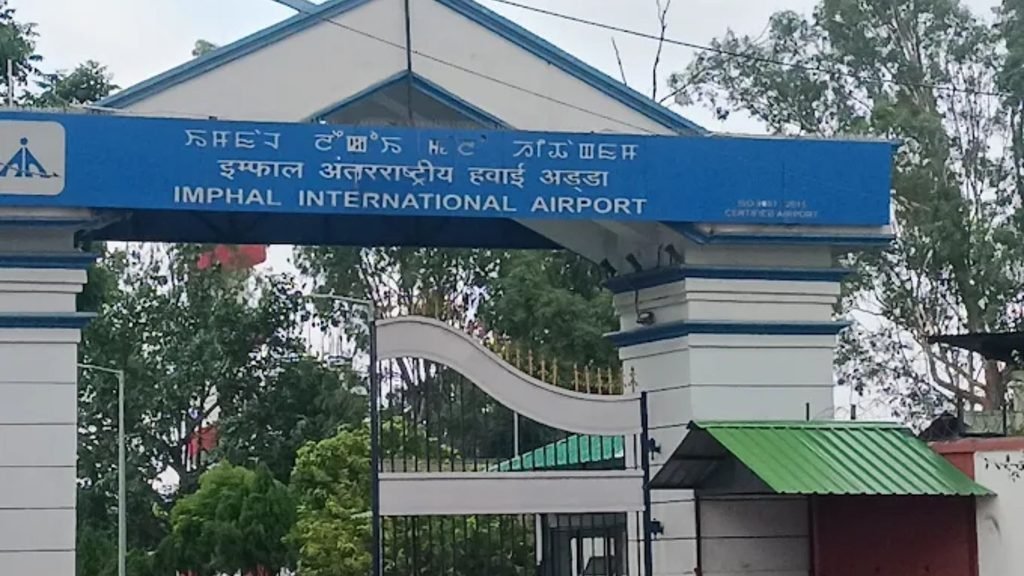
By air: Fly into Imphal Airport (IMF), then take a taxi or shared cab. The drive to Moirang takes roughly 1 to 1.5 hours. Direct flights connect Imphal with Delhi, Kolkata, Guwahati and Bengaluru.
By road: From Imphal, take National Highway 2 south to Moirang, then follow local roads to Sendra, Thanga or the park gate. A private cab for a day trip typically costs about ₹2,500 to ₹4,000 (negotiate). Shared vehicles run to Moirang, but you may need to change there.
By train: There is no operating railway station in Imphal at present, so the nearest major railhead is Dimapur in Nagaland, around 215 km away. Most visitors fly instead.
Local transport: Auto-rickshaws and hired tuk-tuks are the easiest way to get between Moirang, Sendra and the park gate. Ask your homestay to arrange this.
What permit do you need to visit Loktak Lake?
There is no separate permit for the lake itself, but Manipur requires an Inner Line Permit (ILP) for Indian citizens who live outside the state.
- Type: Temporary ILP for tourists, valid 30 days, non-renewable.
- Fee: ₹100.
- How to apply: Online at manipurilponline.mn.gov.in, or at the automated kiosks at Imphal Airport, Mao Gate and Jiribam entry points.
- Carry: A valid government photo ID.
- Foreign visitors: Rules for foreign nationals have changed over time, so confirm current requirements with the Manipur Tourism Department or an Indian mission before booking.
Keibul Lamjao National Park: timings, entry fee and boating charges
Published figures vary a lot, so treat these as a guide and confirm at the gate.
- Timings: Official listings differ (some say 9 am to 6 pm), but recent visitors report the gate opens as early as 6 to 7 am and closes around 4 pm. Several sources list Monday as closed.
- Entry fee: Roughly ₹20 to ₹50 for Indian adults, lower for children, and about ₹100 for foreign visitors in some listings. A camera fee and a vehicle fee may apply.
- Local guide: About ₹300 to ₹600. Worth it, as guides know where the ground is firm and where deer are likely to be.
- Boating: Paddle boats take you a short way into the phumdis. Expect about ₹150 to ₹300 per person in a shared boat, or around ₹250 or more for a private boat. Foreign visitors have reported being asked to take private boats.
- What you will do: Climb the viewpoint tower, use the rangers’ binoculars to spot sangai, take a short boat ride and step onto a real phumdi.
- Facilities: There are almost no toilets or food stalls in the park, so bring water and snacks. A small shop run by the Women’s Initiative for Sangai Conservation sits outside the gate and sells local crafts.
- Time needed: 1.5 to 2 hours. Go early for the best chance of seeing deer.
What is the best time to visit Loktak Lake?
The best time to visit is October to March. Days are pleasant, skies are clearer, and migratory waterfowl visit from November to February. Mornings can be foggy in November and December, so allow a buffer day.
Monsoon (June to September) is green and dramatic but wet. Summer (April and May) is warm and humid. If you want culture too, plan around the Sangai Festival in Imphal, usually held in late November.
🌿 Love Nature & Wildlife?
Take a break from the beaches and discover the wild side of India! Explore an unforgettable journey from Delhi to Jim Corbett National Park.
Explore Jim Corbett →Wildlife • Jungle Safari • Road Trip Adventure
Where to stay: floating homestays, resorts and hotels
- Floating homestays (Loktak Aquamarine and similar): A private hut on a phumdi reached by boat. Older listings quote about ₹1,000 per person per night with breakfast and dinner, so expect a bit more now.
- Thanga homestays (for example Maipakchao Homestay): About ₹1,000 to ₹1,500 per person including meals.
- Sendra Park & Resort and Sendra Island lodge: The comfortable choice with lake views. Listed rates start around ₹4,000 to ₹5,000 plus GST per night.
- Imphal hotels: Budget rooms start from about ₹900 to ₹1,500, mid-range hotels average about ₹2,300, and 4-star hotels start around ₹4,000.
Book early from November to February. Floating huts are simple, with shared bathrooms in many cases, and the boat transfer means light luggage is best.
What is the famous food around Loktak Lake? (approximate prices)
Meitei cuisine is fish-forward, fermented, fresh and lightly spiced. These are typical local prices, which vary by place and season.
- Nga atoiba thongba (fish curry with local herbs): ₹120 to ₹250
- Eromba (mashed vegetables with fermented fish and chilli): ₹80 to ₹150
- Singju (crunchy raw-vegetable salad): ₹40 to ₹80
- Paknam (fish-and-lentil savoury cake): ₹80 to ₹150
- Chak-hao kheer (black rice pudding): ₹60 to ₹120
- Meitei veg or non-veg thali: ₹150 to ₹350
- Lotus stem and local snacks, tea: ₹20 to ₹60
Fish from the lake is the star, and many homestays serve home-cooked dinners. If you cannot handle strong fermented flavours, ask your host for dishes without fermented fish.
How many days are enough for Loktak Lake?
One full day is the minimum, and two days with one night on the lake is ideal. Add a third day if you want Imphal sightseeing.
- 1 day (rushed but doable): Leave Imphal at 6 am. Visit Keibul Lamjao at opening time, then Sendra viewpoint and a lake boat ride, with lunch at Moirang. Return by evening.
- 2 days (recommended): Day 1, drive from Imphal, visit INA Memorial in Moirang (closed Sundays), see Sendra at sunset and stay in a homestay. Day 2, sunrise canoe ride, Keibul Lamjao National Park, shopping at the WISC shop, and return.
- 3 days: Add Imphal’s Kangla Fort, Ima Keithel (the women-run market), Loukoi Pat and Phubala or Thanga.
Approximate budget per person (2 days, excluding flights)
- Budget: about ₹3,500 to ₹5,000 (homestay, shared transport, local meals)
- Mid-range: about ₹6,000 to ₹9,000 (private cab, better stay, guide)
- Comfort: ₹10,000 and above (resort stay, private boat and cab)
Smart and responsible travel tips
- Check current travel advisories and local conditions for Manipur before you go, as the situation has changed from time to time.
- Carry your ID, ILP, cash (ATMs near the lake can be unreliable) and a dry bag for your phone.
- Wear closed shoes and long sleeves, as the ground is muddy and mosquitoes are common.
- Keep voices low in the park, never feed wildlife and carry out all plastic.
- Hire local boatmen and guides, and buy crafts from community shops.
Frequently asked questions about Loktak Lake and Keibul Lamjao
How is Loktak Lake floating?
The lake itself does not float. Thick mats of vegetation, soil and decaying roots called phumdis are lighter than water, so they float on it. Like icebergs, most of their mass is underwater.
Can we drink Loktak Lake water?
Not straight from the lake. It supplies drinking water after treatment, but sewage, silt and algae affect its quality. Drink bottled or treated water.
Is there a snake in Loktak Lake?
Yes, wetland reptiles are present, and the Indian python is recorded in the area. Tourists rarely see snakes, but wear closed shoes and stay on marked paths.
What are the floating islands of Loktak Lake called?
They are called phumdis. Huts built on them are phumshangs, and circular fishing rings are athaphum.
Where are the floating villages?
Phumdi settlements are spread around the lake’s central and southern parts. Champu Khangpok is the best-known floating village, and Thanga and Sendra are the usual bases for visitors.
Which city is called the floating city?
No Indian city holds that official title. Venice is the one most often called a floating city. In India, Srinagar’s Dal Lake is famous for houseboats, and Loktak is known as the floating lake.
Is there a floating village in Manipur?
Yes. Champu Khangpok on Loktak Lake is a well-known floating village, with huts and a floating school built on phumdis.
What is the world’s largest floating village?
There is no single official record. Villages on Cambodia’s Tonlé Sap lake are often cited as among the largest. Loktak’s claim to fame is the world’s only floating national park.
Which is the 2nd largest freshwater lake in India?
Rankings depend on how you measure and which season you use. Wular Lake in Jammu and Kashmir is usually named India’s largest natural freshwater lake, and Loktak is the largest in Northeast India and commonly ranked among the biggest.
Which is bigger, Sambhar Lake or Chilika Lake?
Chilika is bigger. It is a coastal lagoon of about 1,100 km² or more, while Sambhar is an inland salt lake that is much smaller.
Is Kolleru Lake the largest freshwater lake in India?
Kolleru in Andhra Pradesh is one of India’s largest freshwater lakes, but most lists name Wular Lake as the largest.
Which lake is bigger, Chilika or Vembanad?
Vembanad in Kerala is bigger, at about 2,033 km² in common lists versus about 1,165 km² for Chilika. Vembanad is also India’s longest lake.
Why is Keibul Lamjao National Park famous in the world?
It is the only floating national park on Earth and the last natural home of the endangered sangai, or dancing deer.
On which lake is Keibul Lamjao National Park located?
It is on Loktak Lake in Bishnupur district, Manipur, on the lake’s south-eastern side.
Is Keibul Lamjao a Ramsar site?
The park lies within Loktak Lake, which was designated a Ramsar Wetland of International Importance on 23 March 1990 (site no. 463).
Which animal is Keibul Lamjao National Park famous for?
The sangai (brow-antlered or dancing deer), the state animal of Manipur, which is found nowhere else in the wild.
Final thoughts: is Loktak Lake worth visiting?
Yes, if you want something that feels like no other place in India. A night in a floating hut, a sunrise canoe ride and a glimpse of a sangai on a moving meadow make a trip that stays with you. Go between October and March, apply for your ILP, hire a local guide, stay with a local family, and leave the lake as you found it.
Have a travel story or unforgettable experience to share? Don’t hesitate to write for us! We would love to hear about your journeys, adventures, hidden gems, and memorable moments. Share your experiences with the world, inspire fellow travellers, and let your story become part of someone else’s next great adventure.
Sources used for fact-checking
NASA Earth Observatory (The Floating Islands of India); Wikipedia (Loktak Lake); Drishti IAS (Keibul Lamjao National Park); UNESCO World Heritage tentative list; Manipur ILP portal; Third Eye Traveller, Outlook Traveller and Lonely Planet visitor guides; Wildlife Institute of India and Mongabay-India reporting on the sangai.