




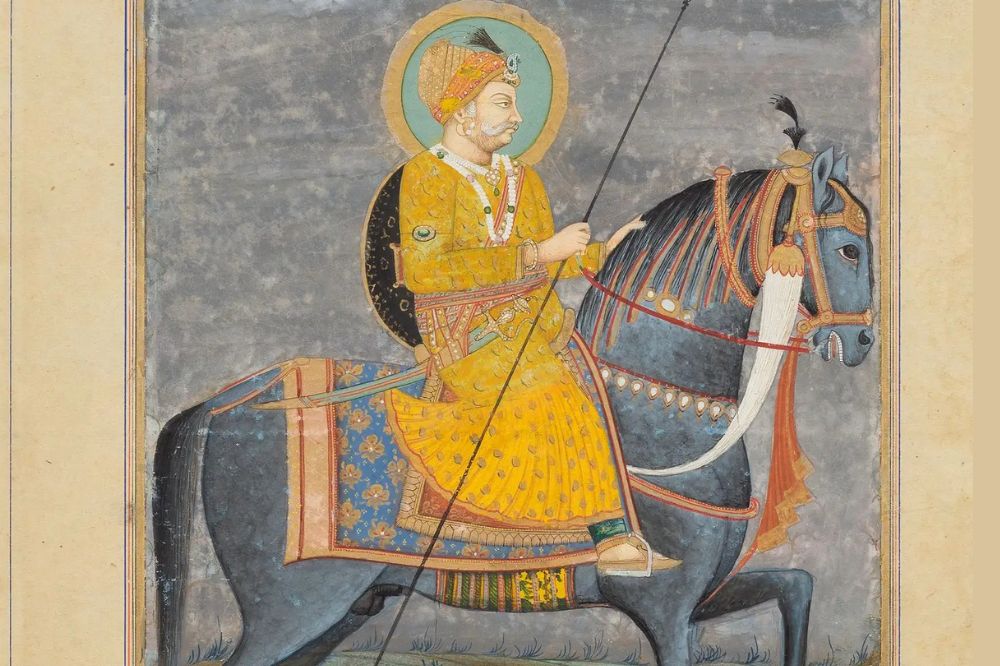
Raja Man Singh of Amber: Complete Life Story, Vansawali and Battles
Few names in medieval Indian history carry as much weight, and as much controversy, as Raja Man Singh I of Amber. Born a Kachhwaha Rajput prince in a small hill kingdom, he rose to become the most powerful general in Emperor Akbar’s empire, a subahdar who governed Kabul, Bihar and Bengal, and, at the same time, a devout Hindu king who rebuilt temples from Varanasi to Vrindavan to Puri. He fought on both sides of history’s ledger, leading the Mughal army against Maharana Pratap at Haldighati, and also restoring the very shrines that earlier invasions had destroyed. This article traces his complete story, his vansawali, his birth, his sixty-seven battles, his temple-building, and his death, year by year.
Vansawali: The Kachhwaha Lineage Behind Man Singh
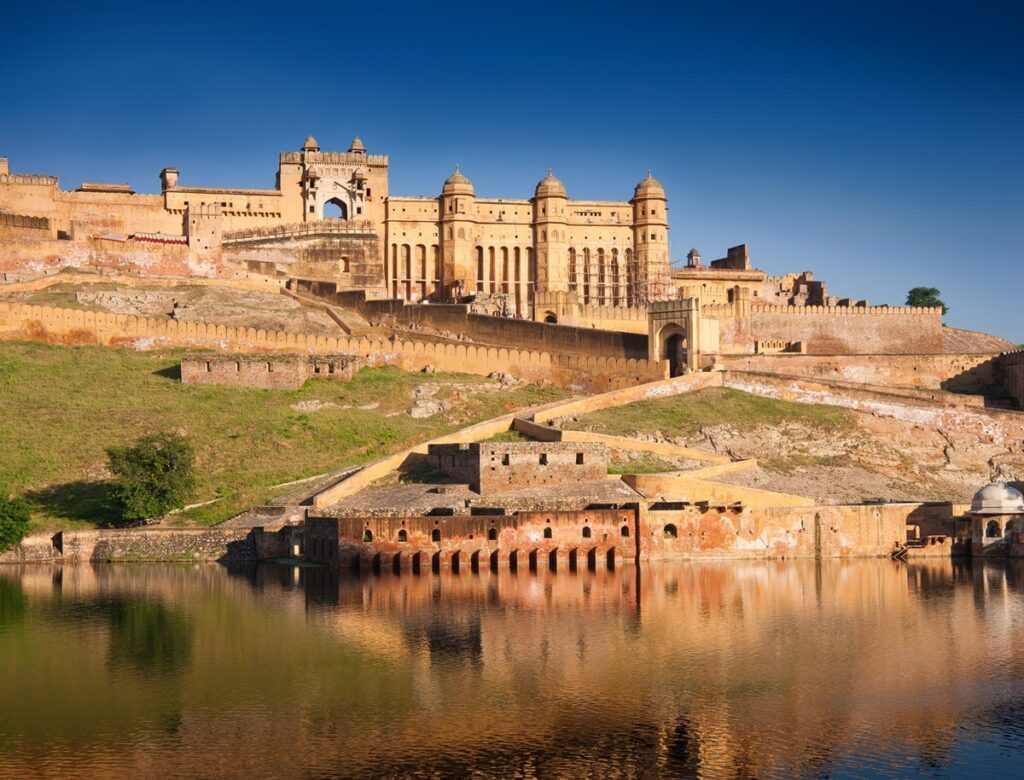
Man Singh belonged to the Kachhwaha Rajput dynasty of Amber (Dhoondhar), a clan that traced its ancestry to the Suryavanshi (solar) lineage. The line that matters most for his story runs through the generations before him:
- Raja Prithviraj Singh I of Amber, an earlier Kachhwaha ruler whose descendants expanded the kingdom’s standing among the Rajput states of Rajputana.
- Raja Bharmal (Bihar Mal), Man Singh’s grandfather, was the first Rajput ruler of note to marry his daughter into the Mughal imperial family, joining Amber’s fortunes to Akbar’s court in 1562. This alliance opened the door for the entire Kachhwaha clan to rise within the Mughal nobility.
- Raja Bhagwant Das, Man Singh’s father, became the 23rd Raja of Amber, reigning from 1574 to 1589. He too served as a high Mughal mansabdar, holding governorships of Lahore and, briefly, Kabul, and was Man Singh’s constant companion in the early campaigns of his career.
- Man Singh’s mother was Rani Bhagawati Ji Sahiba of Amber.
Man Singh himself became the 24th Kachhwaha ruler of Amber, reigning from 1589 to 1614. After him, the throne passed to his son Bhau Singh (1614–1621), then to his grandson Jai Singh I (1621–1667), continuing the line that would later build the city of Jaipur. Man Singh’s own direct descendants came to be known as the Rajawats, a branch that retained ceremonial precedence at the Amber–Jaipur court for generations.
Among his own sons, Jagat Singh, Himmat Singh, Durjan Singh, and Bhau Singh feature repeatedly in the record, Jagat Singh as a battlefield commander in Bihar and Orissa, and Bhau Singh as his eventual successor.
Birth and Early Life (1550–1562)
Man Singh was born on Sunday, 21 December 1550, at Amber, into the household of Raja Bhagwant Das. He arrived into a generation that would shape all of northern India: he was roughly eight years younger than Akbar and about ten years younger than his own kinsman-turned-rival, Maharana Pratap of Mewar.
His childhood coincided with the most consequential diplomatic decision his family ever made. In 1562, when Akbar visited Ajmer, Raja Bihar Mal (Bharmal) of Amber offered his eldest daughter in marriage to the young emperor. This marriage brought the Kachhwaha family directly into the imperial household, and the young Kunwar (Prince) Man Singh was effectively drawn into Akbar’s inner circle from that point onward, growing up around the Mughal court even as he remained heir to Amber’s throne.
From boyhood, Man Singh was trained rigorously in both Rajput and Mughal military traditions — horsemanship, archery, sword-craft, and the administrative skills expected of a future subahdar. This dual training later made him equally comfortable with Rajput and Mughal battle tactics, a rare combination Akbar came to rely on again and again.
Rise at Akbar’s Court: The Navaratna
By his late teens, Man Singh had already been given serious military responsibility. At just seventeen, Akbar appointed him a mansabdar of 5,000, an extraordinary rank for someone so young, placing him among the empire’s most senior commanders from the very start of his career. He was later counted among Akbar’s legendary Navaratnas, the nine gems of the royal court, alongside figures such as Raja Birbal, Raja Todar Mal, Abul Fazl, and Tansen.
Man Singh’s family connection to Akbar deepened further: his aunt (Bihar Mal’s daughter) was married to the emperor, making Man Singh a nephew by marriage within the imperial family, while, ironically, Maharana Pratap of Mewar was also his kinsman through Rajput blood ties. This dual relationship placed Man Singh at the very centre of the defining Rajput–Mughal confrontation of the age.
The Battle of Haldighati (1576): Kinsman Against Kinsman
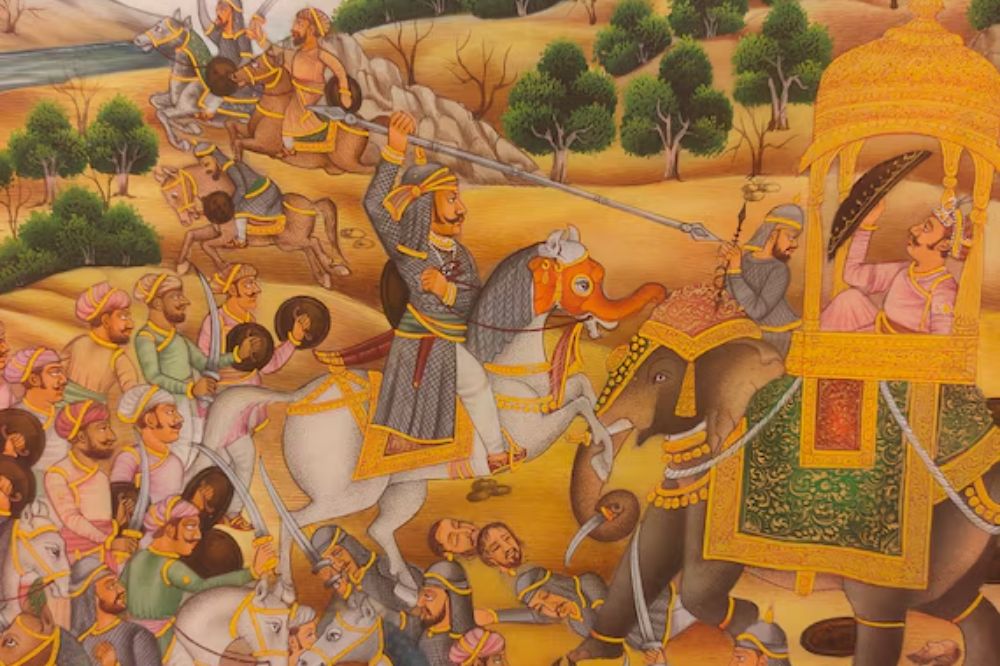
In 1572, Akbar sent Man Singh to Mewar to persuade Maharana Pratap to accept Mughal sovereignty through a treaty, much as other Rajput houses had done. According to traditional accounts, Pratap refused the terms and the meeting ended in insult rather than agreement, though more rigorously sourced modern biographies note that the dramatic “banquet insult” story is not confirmed by contemporary Persian or Rajasthani records and may be a later legend. What is certain is that negotiations failed, and war followed.
The Battle of Haldighati was fought on 18 June 1576 near the Haldighati pass in the Aravalli hills. Pratap commanded around 3,000 horsemen, a body of elephants, and roughly 400 Bhil archers under Rana Punja, along with a small artillery unit led by Hakim Khan Sur. His army was arranged in five wings, with Pratap himself at the centre.
Man Singh led a Mughal force of about 10,000, including some 4,000 Kachhwaha Rajputs alongside Mughal cavalry. Pratap’s opening charge scattered the Mughal advance and left wings, but Man Singh’s counter-charge shifted the momentum and forced Pratap to retreat; fierce fighting followed between Rajput warriors on both sides. The Mughals held the field and inflicted heavy casualties, but failed to capture Pratap, who escaped into the hills. The battle became one of the most romanticised episodes in Rajput memory, a tactical defeat for Mewar, yet a moral victory remembered for Pratap’s defiance. For Man Singh, it was a triumph that cemented his reputation, even as it permanently strained his relationship with the house of Mewar.
The Kabul Campaigns (1581–1586): Crossing the Indus First
Man Singh’s next major test came from the northwest frontier. In 1580, discontented Mughal nobles, unhappy with Akbar’s liberal religious policy, began plotting rebellion. Agitators in Bihar and Bengal proclaimed Akbar’s half-brother, Mirza Muhammad Hakim, governor of Kabul, as the rightful emperor. In February 1581, Mirza Hakim marched on Lahore and besieged its fort.
Akbar marched north himself, with Man Singh at his side. On 8 March 1581, Akbar reached Machhiwara and advanced to the banks of the swollen River Indus. While the main Mughal force hesitated at the crossing, Man Singh was the first to cross the flooded Indus, leading the advance troops onward. Hearing this, Mirza Hakim abandoned Lahore and fled toward Gurband. In July 1581, Kachhwaha troops under Man Singh, fighting alongside the wider Mughal army, stormed and took Gurband, bringing Afghanistan under imperial control. Akbar reached Kabul on 10 August 1581 and appointed Man Singh Hakim (governor) of Kabul. Mirza Hakim was pardoned; his sister Bakht-un-Nissa Begum was made nominal governor, while Hakim continued to administer until his death in July 1582.
The Kabuli chiefs resented being ruled by a Rajput prince, and complaints reached Akbar. Rather than remove Man Singh in disgrace, Akbar transferred him to an equally demanding post, the government of Bengal, replacing him at Kabul with a Muslim officer, a sign of how highly he was still regarded.
Trouble on the frontier was not over. In 1585, the Yusufzai and Mandanr Afghan tribes rose in revolt. Akbar’s first response, an army under Zain Khan, Hakim Abul Fateh and Raja Birbal, ended in disaster, Birbal, one of Akbar’s own Navaratnas, was killed. Akbar sent Raja Todar Mal to restore order and summoned Man Singh to reinforce him. The rebellion’s true stronghold lay beyond the treacherous Khyber Pass. Accompanied by Rao Gopaldas of Nindar, Man Singh forced his way through the pass and decisively defeated five major Afghan tribal confederacies, including the Yusufzai and Mandanr. To commemorate this victory, the Amber state flag was changed from the plain “Katchanar” (green climbing vine on white) to the five-coloured “Pachranga” banner, used until Jaipur’s accession to independent India in 1949.
In 1586, a further Mughal army under Man Singh’s father, Raja Bhagwant Das, conquered Kashmir and annexed it as a district of Kabul province. Man Singh and his father are also credited with bringing improved cannon-casting technology back to Amber from these northern campaigns.
Governor of Bihar (1587–1594): Subduing the Eastern Rajas
In 1587, Akbar appointed Man Singh Subahdar of Bihar, a post he held until 1594. His task was to bring the region’s independent-minded local rajas, many of whom had sheltered Afghan rebels fleeing Delhi, into submission.
His first target was Raja Puranmal of Gidhaur, whose fort fell quickly to the Kachhwaha army; Puranmal’s treasury was seized and his daughter married into Man Singh’s own family. Man Singh then compelled the rajas of Gaya and Kargpur to submit and pay tribute. When Afghan raiders from Bengal tried to exploit the situation and invade Bihar, Man Singh’s son Jagat Singh decisively defeated them, sending 54 captured elephants and the spoils of war back to Akbar’s court, a campaign Abul Fazl praised for combining ability with courage.
The Orissa Campaign (1590–1592): A Hard-Fought Frontier
With Bihar secured, Akbar ordered Man Singh to subdue the Afghan ruler Qatlu Khan Lohani of Orissa. Man Singh set out in April 1590. His advance force, led by Jagat Singh, suffered a serious reverse, several senior Amber commanders, including Bika Rathor, Narupal Charan and Mahesh Das, were killed, and Jagat Singh had to be rescued by the local Raja Hamir Singh (Bir Hambir) and take shelter in the fort of Bishnupur.
Qatlu Khan died soon after, and his son Nasir Khan surrendered, ceding territory and paying a tribute of 150 elephants. But after Nasir’s regent Isa Khan died, the Afghans rebelled again, forcing Man Singh back to Orissa. On 9 April 1592, near Jaleswar, Man Singh won a bloody but decisive battle against the rebels, then pursued them and forced their surrender. He went on to subdue several Hindu rajas of Orissa who had sheltered the fleeing Afghans; the Raja of Khurda resisted stubbornly until several of his forts were stormed and he shut himself inside his capital. Akbar, hearing of the harsh treatment of such an ancient dynasty, ordered Man Singh to show restraint, after which the Khurda Raja surrendered and gave his own daughter in marriage to Man Singh. With this, the conquest of Orissa was complete.
Viceroy of Bengal (1594–1606): Two Decades on the Eastern Frontier
On 17 March 1594, Akbar made Man Singh guardian of Prince Salim (the future Jahangir) and appointed him Viceroy of Bengal. This began the longest and most demanding phase of his career.
- 1595: On 2 April, the Amber army captured the fort of Bhushna. On 7 November, Man Singh founded a new provincial capital, Akbarnagar (Rajmahal), and personally led a campaign against the Afghan chief Isa Bhati, forcing his retreat. Falling seriously ill soon after, he sent his son Himmat Singh to put down a fresh uprising triggered by his illness, successfully suppressed.
- He assisted Lakshmi Narayan, Raja of Cooch Behar, against rival claimants; the grateful ruler gave his sister in marriage to Man Singh and accepted Mughal vassalage.
- Man Singh briefly left for Ajmer, during which Mughal control in Bengal weakened, prompting his return.
- 1601: On 12 February, Man Singh defeated rebel forces near Sherpur-Atia and pursued them for eight miles. He marched on Dacca and compelled Kedar Rai, the zamindar of Bhushna, to submit. He went on to defeat Usman, successor of Qatlu Khan, along the Banar river, and crushed the Arakanese (Magh) pirates raiding the delta. Kedar Rai, captured in a later battle, died before he could be brought before Man Singh.
Across three separate terms as Bengal’s subahdar, Man Singh effectively completed the Mughal conquest of Bengal, one of his greatest, though least romanticised, achievements.
Court Politics: The Succession Crisis (1600s)
As Akbar aged, his court split over the succession. His son Prince Salim had grown addicted to opium and wine and was implicated in the murder of the chronicler Abul Fazl; his own son Khusrau Mirza was seen by many as the more capable heir. Man Singh, whose sister was Salim’s wife and whose nephew was therefore Khusrau, sided, along with Mirza Aziz Koka, with Khusrau’s claim.
When Akbar fell fatally ill in 1605, he nonetheless named Salim his successor. Man Singh never worked against Jahangir once the succession was settled. He was briefly reappointed Subahdar of Bengal on 10 November 1605, but replaced within a year, on 2 September 1606. Jahangir also ordered some of Man Singh’s own architectural additions at his Amber palace undone a small sign of residual distrust.
Final Campaign: The Deccan (1611–1614)
Man Singh’s last active service came in the Deccan. In 1611, the southern provinces of Ahmednagar, Berar and Khandesh rose in defiance of Mughal authority under the formidable general Malik Ambar. Jahangir dispatched Man Singh, by then over sixty, to suppress the revolt. It was during this final posting that his long career — spanning some sixty-seven major battles across Kabul, Balkh, Bukhara, Bengal, and central and southern India, drew to its close.
Temple Builder and Zirnodwar (Restorer) of Hindu Shrines
Away from the battlefield, Man Singh’s other legacy was architectural and religious:
- Kashi Vishwanath Temple, Varanasi — reconstruction and patronage of this sacred Shiva temple; he also built Man Mandir Ghat along the Ganga, which still stands.
- Govind Dev Temple, Vrindavan — his most famous commission: a seven-storeyed red sandstone temple built for Srila Rupa Goswami, disciple of Sri Chaitanya Mahaprabhu, at a reported cost of one crore rupees. Its surviving four-storey structure remains a Vrindavan landmark.
- Shila Devi Temple, Amber Fort — Man Singh brought the image of Shila Devi from Jessore in Bengal and installed her as the Amber royal family’s tutelary goddess.
- Kanak Vrindavan, Amber — a Krishna temple near Amber Ghati, still known by this name.
- Jagannath Temple, Puri — restoration and re-establishment following earlier disruption of worship.
- Ram Mandir, Saidpur (near Islamabad, present-day Pakistan) — built during his northern campaigns; survives today.
- Temples and ghats at Benaras, Allahabad, Mathura, Gaya, Haridwar, and Dwarka, plus a Ganesh temple at Rohtas Fort and Lakshmi Narayan/Shiva temples at Baikunthpur, Bihar.
Some popular-history writers argue this side of his legacy has been overshadowed by his role as a Mughal general, that a ruler who rebuilt temples from Kashi to Puri to Dwarka deserves recognition as a protector of dharmic institutions too. This remains genuinely debated among historians.
Man Singh also beautified the Amber palace itself, additions Jahangir later partly reversed after his death.
The Poet-Saint Connection: Tulsidas
Tradition holds that Man Singh’s son, Jagat Singh I, received part of his education from the great poet-saint Goswami Tulsidas, author of the Ramcharitmanas, and that Man Singh himself regularly attended Tulsidas’s religious discourses, placing his court at the intersection of Mughal statecraft and the great Bhakti literary movement.
Death at Ellichpur (1614)
Raja Man Singh I died a natural death on 6 July 1614 at Ellichpur (present-day Achalpur, Maharashtra), still on active service in the Deccan under Jahangir. He was around 63, having spent over five decades in continuous military and administrative service, first to Akbar, then to Jahangir.
He was succeeded by his son Bhau Singh, and the line continued through his grandson Jai Singh I (r. 1621–1667), who carried Amber’s prestige to new heights.
Legacy
Man Singh’s legacy remains genuinely contested, remembered by some chiefly as the general who fought fellow Rajputs at Haldighati, and by others as the far more complex figure revealed by the fuller record: conqueror of Kabul, pacifier of the Khyber, completer of the Mughal absorption of Bengal and Orissa, and builder of Hindu temples on a scale matched by very few rulers of his era. Modern scholarship, most notably Rima Hooja’s recent biography, has tried to move past both purely heroic and purely critical framings by relying closely on Persian and Rajasthani sources rather than popular legend.
Frequently Asked Questions
When was Raja Man Singh born and when did he die?
21 December 1550 at Amber to 6 July 1614 at Ellichpur, around 63 years of age.
Who were his parents?
Raja Bhagwant Das, 23rd Raja of Amber, and Rani Bhagawati Ji Sahiba.
What was his role at Haldighati?
He commanded the roughly 10,000-strong Mughal army against Maharana Pratap on 18 June 1576. The Mughals held the field, but Pratap escaped.
How many battles did he fight?
Around sixty-seven major battles and campaigns across Kabul, Balkh, Bukhara, Bengal, and central/southern India.
Which temples did he build?
Govind Dev Temple (Vrindavan), Shila Devi Temple Amber Fort, Kashi Vishwanath and Man Mandir Ghat (Varanasi), Ram Mandir (Saidpur), and restoration work at Jagannath Temple (Puri), among others.
Who succeeded him?
His son Bhau Singh (1614), then grandson Jai Singh I (1621).