




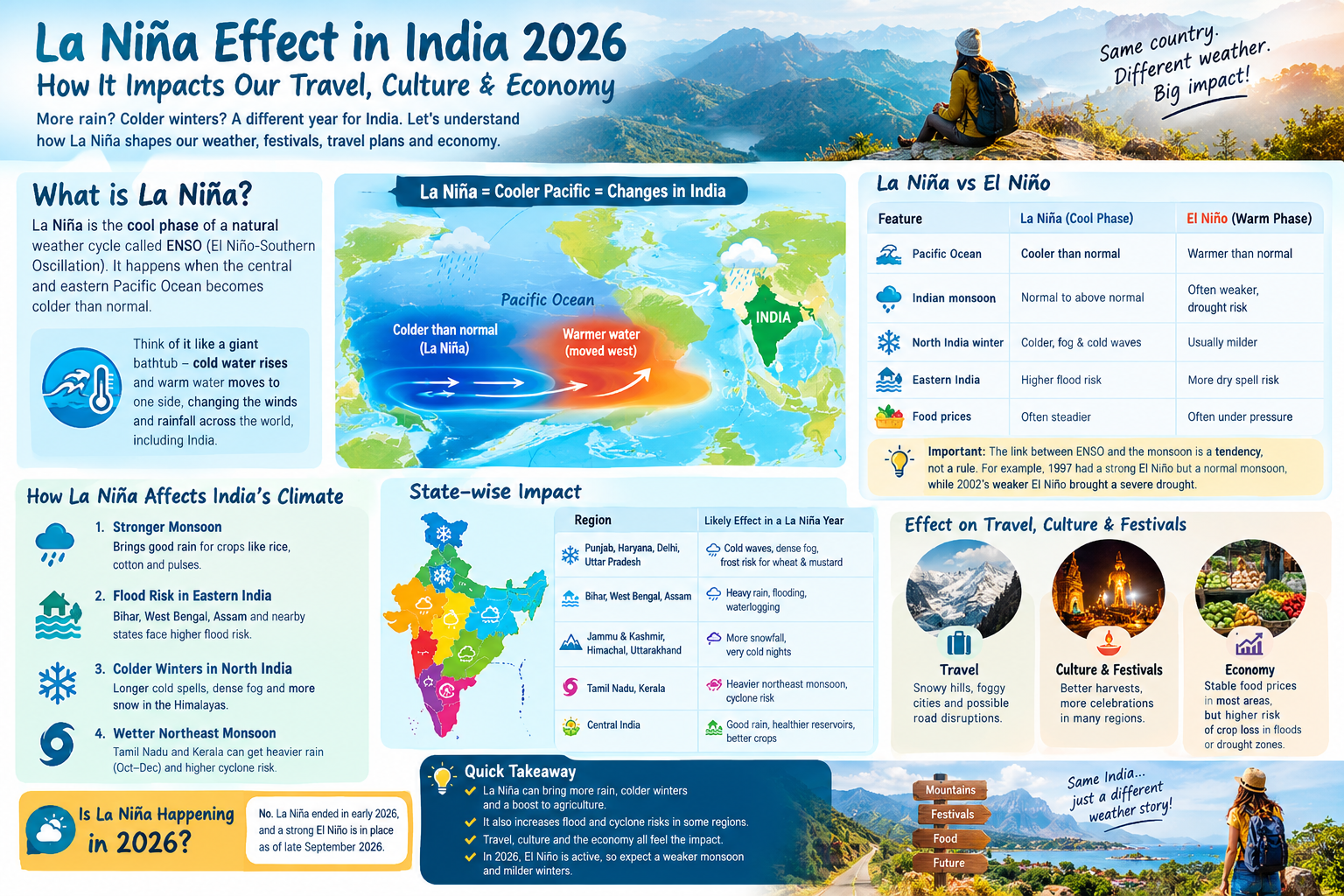
The La Niña effect in India is a big reason why some years bring heavy rain and cold, foggy winters, while others bring drought and mild winters. La Niña is a natural cooling of the Pacific Ocean. It changes the monsoon, the winter, our holiday plans, our festivals and even the price of vegetables.
In this guide, you will learn what La Niña is, how it affects India, and what is happening right now in 2026.
La Niña is not active in India right now. La Niña ended in early 2026, and a strong El Niño is in place as of late September 2026. [1][2] When La Niña is active, India usually gets a stronger monsoon and colder winters. When El Niño is active, India often gets a weaker monsoon and milder winters.
What You Will Learn
- What La Niña means
- La Niña vs El Niño
- The La Niña effect in India’s climate
- State-wise impact
- Effect on travel
- Effect on culture and festivals
- Effect on the economy
- Is La Niña happening in 2026?
- FAQs and sources
What Is La Niña?
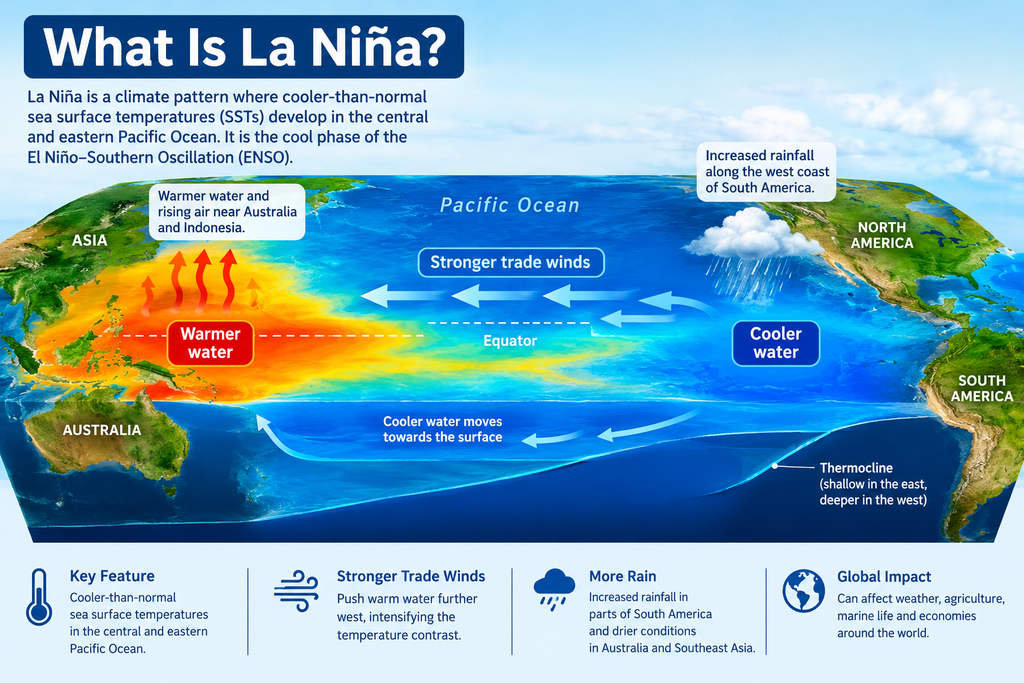
La Niña is the cool phase of a natural weather cycle called ENSO (El Niño-Southern Oscillation). It happens when the central and eastern Pacific Ocean becomes colder than normal. [8]
Easy way to understand it: Imagine the Pacific Ocean as a giant bathtub. During La Niña, strong winds push warm water to one side, and cold water rises from below on the other side. It is like blowing on hot soup: the heat moves to one side of the bowl.
This cold patch changes winds and rainfall across the world, including India.
What Causes La Niña?
- Strong trade winds: Winds over the Pacific blow stronger than usual and push warm surface water towards Indonesia and Australia. [8]
- Cold water rising: Cold, nutrient-rich water comes up in the eastern Pacific and cools the sea surface. [8]
- Air and ocean working together: Changes in air pressure and ocean temperature keep the pattern going for months. [8]
How Long Does La Niña Last?
La Niña usually lasts about 9 to 12 months. Some strong events can last up to two years. [8]
La Niña vs El Niño: What Is the Difference?
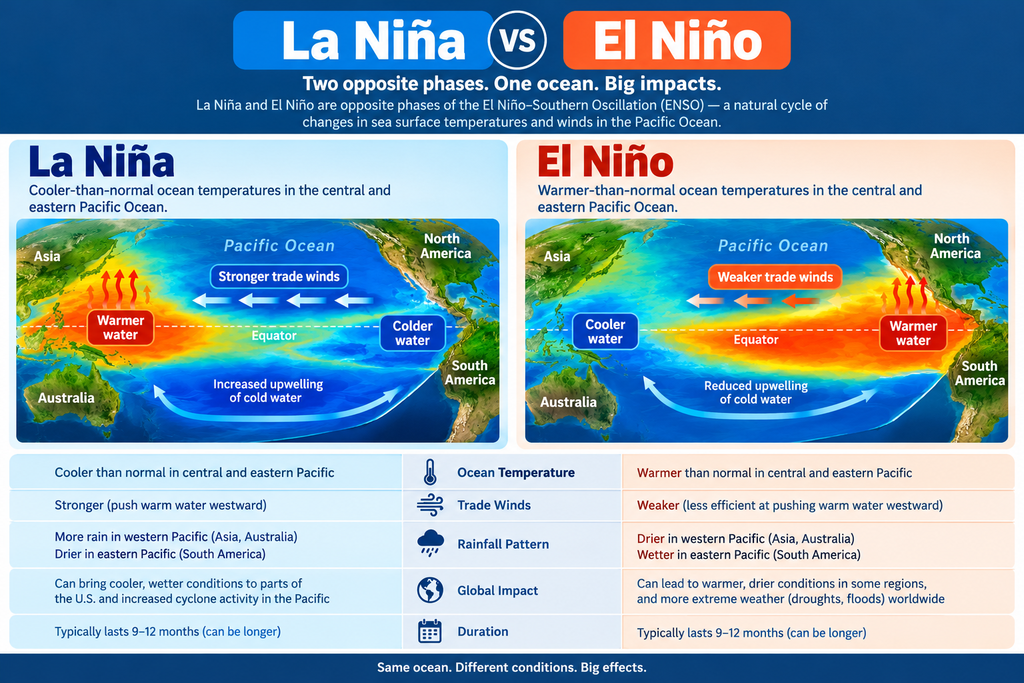
El Niño is the warm phase of ENSO. La Niña is the cool phase. [6]
| Feature | La Niña | El Niño |
|---|---|---|
| Pacific Ocean | Cooler than normal | Warmer than normal |
| Indian monsoon | Usually normal to above normal | Often weaker, with drought risk |
| North India winter | Colder, with fog and cold waves | Usually milder |
| Eastern India | Higher flood risk | More dry spell risk |
| Food prices | Often steadier | Often under pressure |
Important: The link between ENSO and the monsoon is a tendency, not a rule. For example, 1997 had a very strong El Niño but a normal monsoon, while the weaker El Niño of 2002 brought a severe drought. [5]
The La Niña Effect in India’s Climate
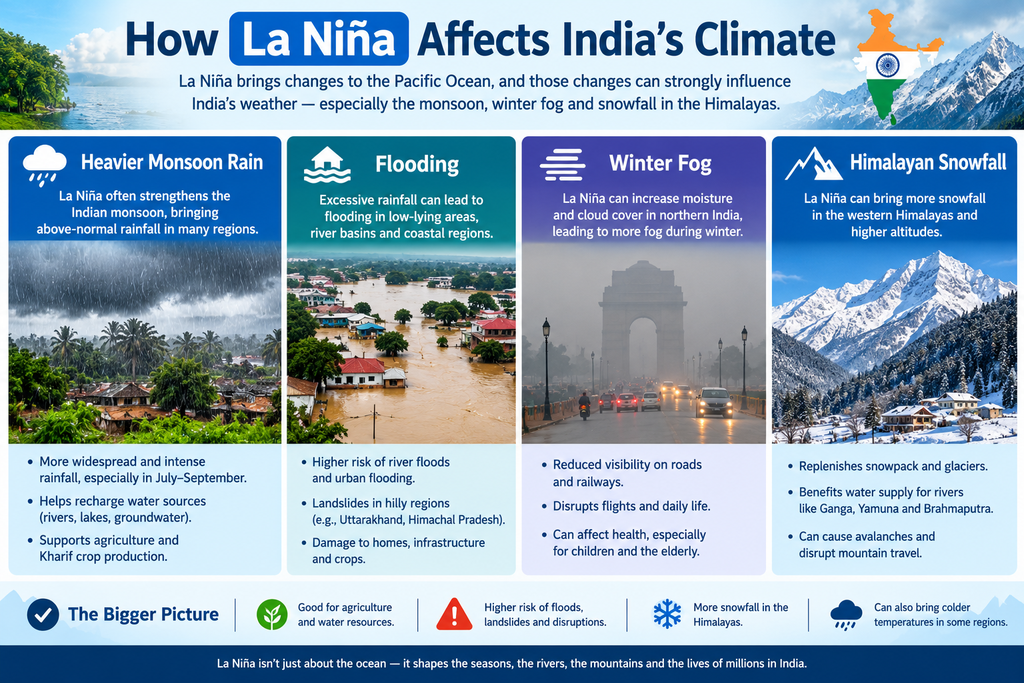
1. A Stronger Monsoon
India gets over 70% of its yearly rain from the southwest monsoon (June to September). [7] La Niña usually supports normal to above-normal rain in these months. [8] This is good news for crops like rice, cotton and pulses.
2. Flood Risk in Eastern India
Heavy rain can also cause floods. Bihar, West Bengal, Assam and other eastern states face a higher risk of waterlogging and flood damage. [8]
3. Colder Winters in North India
La Niña years are often linked with longer cold spells and thick fog in North India. Delhi, Lucknow and Jaipur feel the chill most, and the Himalayan states usually get more snow. This is a general pattern, and local weather systems can change it from year to year.
4. Wetter Northeast Monsoon in the South
Tamil Nadu and Kerala can get heavier rain between October and December, and the chance of Bay of Bengal cyclones can rise.
La Niña Effect in India: State-Wise Impact
| Region | Likely Effect in a La Niña Year |
|---|---|
| Punjab, Haryana, Delhi, Uttar Pradesh | Cold waves, dense fog, frost risk for wheat and mustard |
| Bihar, West Bengal, Assam | Heavy rain, flooding, waterlogging |
| Jammu & Kashmir, Himachal, Uttarakhand | More snowfall, very cold nights |
| Tamil Nadu, Kerala | Heavier northeast monsoon, cyclone risk |
| Central India | Good rain, healthier reservoirs, better crops |
Planning a hill trip? In a La Niña year, the hills can get more snow in winter, so check the weather before you go. For milder-season ideas, see our list of cool places in Himachal. In Uttarakhand, the Kainchi Dham trip guide can help you plan a calm hill visit, but keep an eye on snow and road updates in cold months.
How La Niña Affects Travel in India
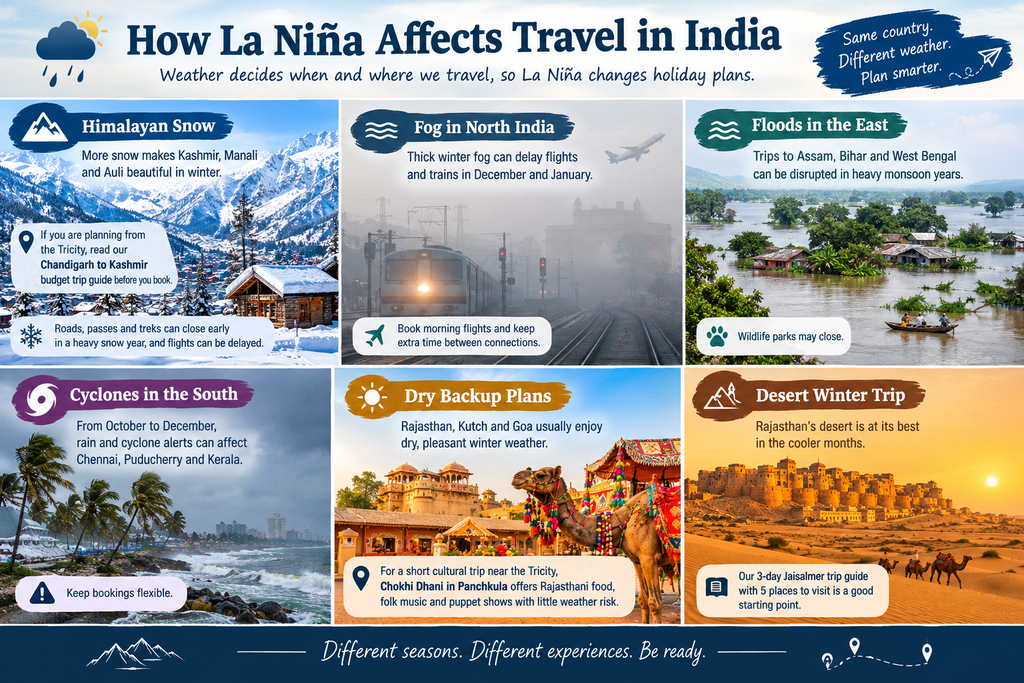
Weather decides when and where we travel, so La Niña changes holiday plans.
- Himalayan snow: More snow makes Kashmir, Manali and Auli beautiful in winter. If you are planning from the Tricity, read our Chandigarh to Kashmir budget trip guide before you book. Roads, passes and treks can close early in a heavy snow year, and flights can be delayed.
- Fog in North India: Thick winter fog can delay flights and trains in December and January. Book morning flights and keep extra time between connections.
- Floods in the east: Trips to Assam, Bihar and West Bengal can be disrupted in heavy monsoon years. Wildlife parks may close.
- Cyclones in the south: From October to December, rain and cyclone alerts can affect Chennai, Puducherry and Kerala. Keep bookings flexible.
- Dry backup plans: Rajasthan, Kutch and Goa usually enjoy dry, pleasant winter weather. For a short cultural trip near the Tricity, Chokhi Dhani in Panchkula offers Rajasthani food, folk music and puppet shows with little weather risk.
- Desert winter trip: Rajasthan’s desert is at its best in the cooler months. Our 3-day Jaisalmer trip guide with 5 places to visit is a good starting point.
Tip: Always buy travel insurance, choose refundable tickets and check the IMD forecast before you travel.
How La Niña Affects Indian Culture and Festivals

Many Indian festivals and foods are linked to the farming year, so rain and cold shape how we celebrate.
- Harvest festivals: Lohri, Makar Sankranti, Pongal, Magh Bihu and Baisakhi are happier and bigger after a good harvest. After a poor harvest, people spend less.
- Winter food: Cold North Indian winters bring sarson ka saag with makki di roti, gajak, rewri, jaggery sweets and warm milk.
- Clothing and crafts: Cold winters increase demand for shawls, woollens and Kullu caps, which helps artisans.
- Monsoon in art and music: Malhar raga, Kajri songs, Teej in Rajasthan and Haryana, and Onam in Kerala all celebrate the rains.
How La Niña Affects the Indian Economy
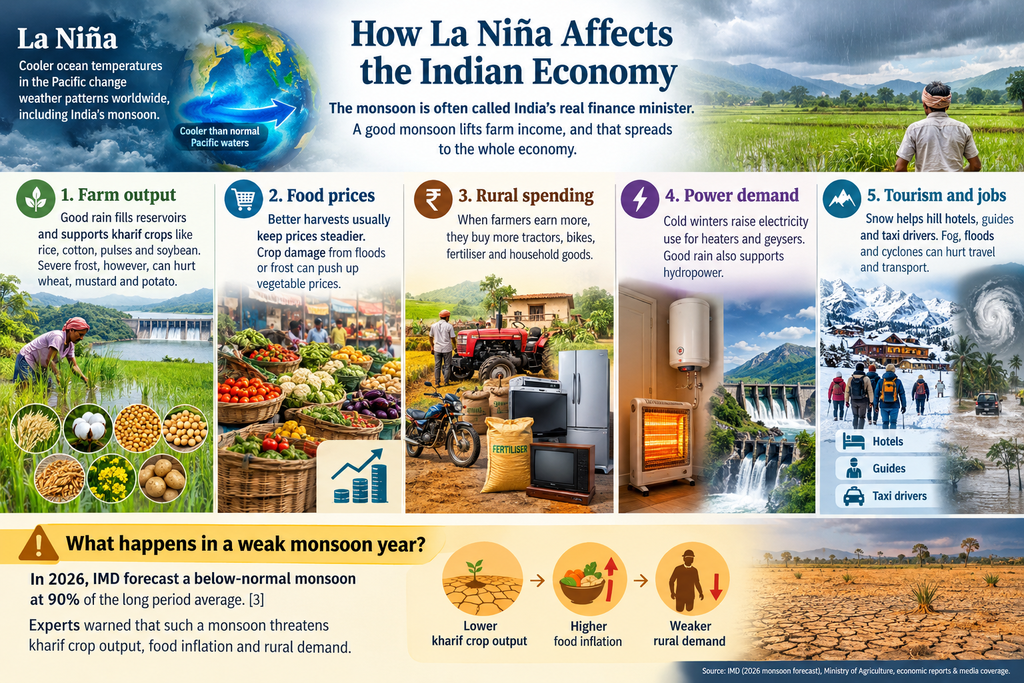
The monsoon is often called India’s real finance minister. A good monsoon lifts farm income, and that spreads to the whole economy.
- Farm output: Good rain fills reservoirs and supports kharif crops like rice, cotton, pulses and soybean. Severe frost, however, can hurt wheat, mustard and potato.
- Food prices: Better harvests usually keep prices steadier. Crop damage from floods or frost can push up vegetable prices.
- Rural spending: When farmers earn more, they buy more tractors, bikes, fertiliser and household goods.
- Power demand: Cold winters raise electricity use for heaters and geysers. Good rain also supports hydropower.
- Tourism and jobs: Snow helps hill hotels, guides and taxi drivers. Fog, floods and cyclones can hurt travel and transport.
What happens in a weak monsoon year? In 2026, IMD forecast a below-normal monsoon at 90% of the long period average. [3] Experts warned that such a monsoon threatens kharif crop output, food inflation and rural demand. [5]
Is La Niña Happening Now in India? (2026 Update)
No. Here is the timeline of 2026:
- August 2025 to February 2026: La Niña was active. [2]
- March to May 2026: Conditions returned to neutral. [2]
- June 2026: The Niño 3.4 index crossed the El Niño threshold, [2] and NOAA issued an El Niño advisory on 11 June 2026. [5]
- Late September 2026: IMD said a strong El Niño continues in the equatorial Pacific. [1]
The Indian Ocean Dipole (IOD) was expected to stay neutral during the 2026 monsoon, which means it was not expected to offset El Niño’s drying effect. [2] A positive IOD can bring extra rain and partly offset El Niño. [4]
What should you expect this winter? In general, El Niño winters tend to be milder in North India than La Niña winters, but this is not guaranteed. IMD said it will release its November 2026 rainfall and temperature outlook at the end of October, so check that for your state. [1]
Frequently Asked Questions
How will La Niña affect India?
La Niña usually brings a stronger monsoon, colder North Indian winters, heavier Himalayan snow, flood risk in the east and a wetter northeast monsoon in the south. These are tendencies, not guarantees.
Will 2026 be El Niño or La Niña in India?
2026 is an El Niño year. La Niña faded by February 2026, conditions were neutral from March to May, and El Niño developed from June. [2] IMD confirmed in late September that a strong El Niño is still present. [1]
Will there be El Niño or La Niña in 2026?
Both appeared in 2026, one after the other. La Niña ended early in the year, and El Niño took over from June. [2] For the rest of 2026, El Niño is the main driver.
Will La Niña affect India?
Yes, La Niña usually affects India through the monsoon and winter temperatures. But other factors, like the Indian Ocean Dipole, can make the effect stronger or weaker. [4]
Will 2026 be colder than 2025 in India?
Not necessarily. El Niño years usually bring milder northern winters than La Niña years, though cold days and fog can still happen. Check IMD’s winter outlook for your state. [1]
What is the difference between El Niño and La Niña?
El Niño is the warm phase of ENSO and La Niña is the cool phase. [6] In India, El Niño often means a weaker monsoon and La Niña often means a stronger one. [6]
How does La Niña affect the Indian economy?
A good monsoon supports crops, rural income and steadier food prices. Floods, frost and fog can cause losses in some regions.
Will La Niña return in 2027?
It is too early to say. ENSO forecasts are updated every month, so check the latest NOAA, WMO and IMD updates.
Key Takeaways
- La Niña is the cool phase of ENSO, and it usually means a stronger monsoon and colder North Indian winters.
- It can help farmers but also cause floods, frost and fog.
- It affects travel, festivals, food and the economy.
- In 2026, La Niña is over and a strong El Niño is in place. [1][2]
- Check IMD updates before planning crops or trips.
Sources – All images created by Chatgpt
- India Meteorological Department (Ministry of Earth Sciences), Press Release, 30 September 2026: Seasonal outlook for post-monsoon rainfall and October 2026 rainfall and temperature. https://mausam.imd.gov.in/
- WION, “IMD tracks El Niño growth as concerns mount over India’s rainfall outlook”. https://www.wionews.com/india-news/el-nino-india-monsoon-imd-low-rainfall-forecast-2026-1781340726676
- APEDA AgriExchange, “Monsoon Advances Amid Emerging El Nino Concerns” (India report). https://agriexchange.apeda.gov.in/MarketReport/99999060520267216235129.pdf
- Moneylife, “Skymet Sounds the Alarm: India Stares Down a 70% Drought Risk as El Niño Tightens Its Grip on the 2026 Monsoon”.https://www.moneylife.in/article/skymet-sounds-the-alarm-india-stares-down-a-70-percentage-drought-risk-as-el-nio-tightens-its-grip-on-the-2026-monsoon/81396.html
- Anantam IAS, “El Niño Returns: Why Scientists Fear a Big, Costly Event and What It Means for India’s Monsoon”. https://anantamias.com/current-affairs/el-nino-2026-declared-monsoon-india-impact/?pdf=1
- CivilsDaily, “El Niño Likely to Develop After July 2026: WMO”.https://www.civilsdaily.com/news/el-nino-likely-to-develop-after-july-2026-wmo/
- Superkalam, “High chances of El Niño after July, says WMO” (4 March 2026). https://superkalam.com/current-affairs/04-03-2026/high-chances-of-el-ni-o-after-july-says-wmo-pg8-b530344c-8225-498c-aad2-541427ea49ef
- Vajiram & Ravi, “La Nina, Causes, Characteristics, Economic & Environmental Impacts” (19 March 2026). https://vajiramandravi.com/current-affairs/la-nina/